The Interpretation Battlespace
How Narrative Systems, Algorithms, and Generative Media Shape Modern Conflict

Abstract
Modern conflict increasingly unfolds within digitally mediated information ecosystems where perception forms faster than traditional analysis. This paper introduces the concept of the interpretation domain—the cognitive environment in which narratives, algorithmic infrastructure, and generative media interact to shape how events are understood. Drawing on contemporary examples of AI‑generated propaganda and platform‑native distribution networks, the paper examines how narratives now propagate through engagement‑driven systems rather than traditional broadcast channels. It argues that influence operations are no longer limited to isolated messaging campaigns but function as emergent properties of interconnected digital systems. As generative media accelerates narrative production and algorithmic platforms determine visibility, the contest to shape interpretation increasingly precedes strategic decision‑making. Understanding these dynamics is essential for governments, analysts, and institutions navigating modern geopolitical competition.
Executive Summary
The character of modern conflict is shifting from the control of territory to the control of interpretation. In contemporary information ecosystems, narratives about events often stabilize across digital platforms before governments, institutions, or analysts have fully verified what occurred. Algorithmic media systems prioritize emotionally engaging content, while generative artificial intelligence enables the rapid production of persuasive visual and narrative artifacts. Together, these forces are transforming how influence operations function.
This paper argues that strategic competition increasingly unfolds within the interpretation domain—the cognitive environment in which audiences assign meaning to events. Within this domain, narrative systems simplify complex developments into emotionally resonant stories, algorithmic platforms determine which interpretations gain visibility, and generative media accelerates the production of persuasive content designed for digital circulation.
Several structural dynamics characterize this emerging environment. First, narratives propagate through algorithmic amplification, meaning engagement signals rather than institutional authority often determine which interpretations dominate public discourse. Second, the rise of generative propaganda enables actors to continuously produce media artifacts optimized for social platforms, including animations, memes, and stylized videos that condense geopolitical events into emotionally powerful narratives. Third, the saturation of digital information ecosystems is destabilizing traditional models of virality, shifting influence toward symbolic or “visceral” narrative anchors that persist in public memory.
Recent geopolitical information contests illustrate these dynamics. AI‑generated propaganda artifacts—such as stylized animations circulating across social media networks—demonstrate how narrative messaging is increasingly embedded within platform‑native media ecosystems rather than distributed solely through official state channels. These artifacts often propagate through intermediary distribution accounts that resemble digital news feeds, enabling narrative content to blend into everyday online discourse while benefiting from algorithmic engagement dynamics.
As narrative production accelerates, audiences increasingly rely on trust networks—journalists, analysts, influencers, and community leaders—to filter competing signals. Narratives that gain support within these networks are more likely to persist and shape public understanding of events.
The strategic implications are significant. Actors capable of aligning narrative systems with algorithmic incentives and generative media capabilities can influence how crises, conflicts, and geopolitical developments are interpreted by global audiences. In this environment, shaping interpretation becomes a central dimension of strategic competition.
Figure 1 — The Interpretation Battlespace Model
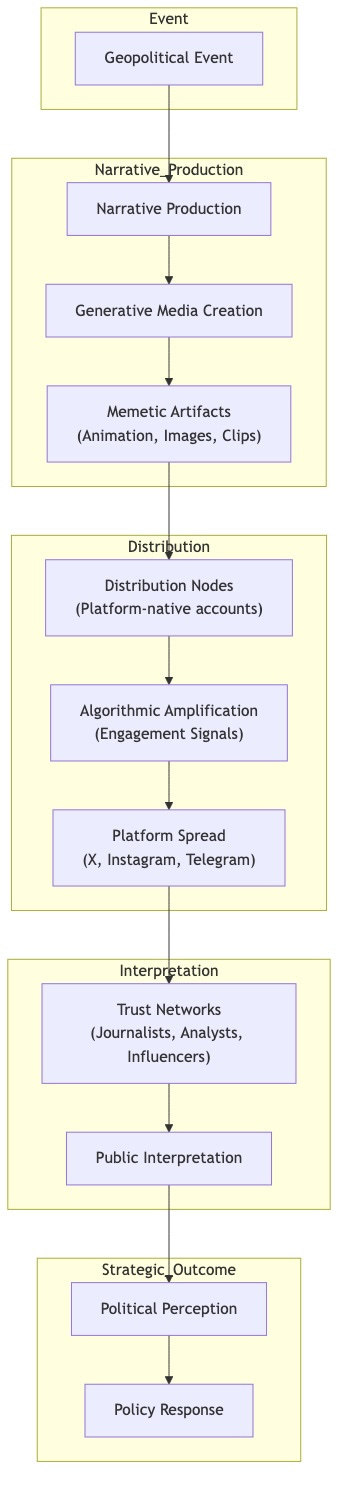
(Conceptual model of the interpretation domain. A geopolitical event triggers narrative production and generative media creation, producing memetic artifacts such as images, animations, and short‑form clips. These artifacts propagate through platform‑native distribution nodes where algorithmic amplification prioritizes emotionally engaging content. As narratives spread across platforms, they enter trust networks composed of journalists, analysts, and influencers who act as interpretive filters. The resulting public interpretation shapes political perception and can ultimately influence policy responses.)
1. Introduction: The Changing Nature of Conflict
Over the past two decades, the character of conflict has begun to shift from the control of territory to the control of interpretation. Digital platforms, algorithmically curated media ecosystems, and rapid advances in generative artificial intelligence have fundamentally altered how information is created, distributed, and understood. Events are no longer interpreted only after facts are established; instead, competing narratives emerge almost immediately, shaping perception long before formal analysis can occur. In this environment, the struggle to define what events mean increasingly becomes the first arena of strategic competition.
Figure 1 illustrates this emerging battlespace, mapping how geopolitical events move through narrative production, generative media creation, algorithmic amplification, and trust networks before stabilizing as public interpretation and ultimately influencing political perception and policy response.
Historically, influence operations and propaganda were largely mediated through centralized institutions such as state broadcasters, newspapers, and formal political messaging. The pace of narrative dissemination was comparatively slow, constrained by production costs and distribution mechanisms. Audiences consumed information through relatively stable channels, allowing institutions time to assess events and respond to emerging narratives.
Today, that environment no longer exists.
Modern information ecosystems are structured around algorithmically driven platforms that continuously prioritize content according to engagement signals. In this environment, narratives do not simply spread through traditional channels; they are amplified, reshaped, and sometimes manufactured through automated systems designed to maximize attention. Content that provokes emotional engagement—whether outrage, fear, humor, or curiosity—is more likely to surface and circulate across networks. As a result, the mechanisms that govern information visibility increasingly shape how events are perceived by audiences in real time.
At the same time, generative artificial intelligence has dramatically lowered the cost of producing persuasive media. Tools capable of generating images, video, audio, and text allow actors—state and non-state alike—to rapidly produce large volumes of narrative content tailored to specific audiences. What once required professional production teams can now be created by small groups or individuals operating with limited resources. The result is an information environment characterized by unprecedented narrative saturation.
These dynamics have profound implications for conflict and strategic competition. In many cases, the interpretation of events now stabilizes within networked digital ecosystems before the underlying facts are fully understood. Public perception can crystallize rapidly around emotionally resonant narratives that circulate through social platforms, influencer networks, and online communities. Once these narratives gain traction, they often shape political responses, media coverage, and strategic decision-making.
This emerging environment suggests that modern conflict increasingly unfolds within what may be described as the interpretation domain—the cognitive space in which individuals and institutions assign meaning to events. Within this domain, narratives compete for attention, algorithms determine amplification, and generative media accelerates the production of persuasive content. The strategic contest is therefore not limited to physical actions on the battlefield but extends to the processes through which those actions are interpreted by audiences.
Understanding how narrative systems interact with algorithmic infrastructure and generative media is essential for analyzing contemporary influence operations. Rather than treating propaganda as a collection of isolated messages, it is increasingly necessary to view influence as an emergent property of interconnected digital systems.
This paper examines how these systems are reshaping the landscape of modern conflict. It introduces the concept of the interpretation domain and explores the mechanisms through which narratives propagate within algorithmically mediated environments. It then considers the role of generative media in accelerating narrative production and examines how influence operations increasingly adopt the visual and cultural language of internet-native communication. Finally, the paper assesses the strategic implications of these developments for governments, institutions, and societies navigating an increasingly contested information environment.
2. The Interpretation Domain
In modern information ecosystems, the first contest surrounding any major event is increasingly not over the event itself, but over its meaning. Before facts are fully verified or strategic outcomes assessed, competing narratives begin to circulate across digital platforms, shaping how audiences interpret what has occurred. This phenomenon can be understood as the emergence of the interpretation domain—the cognitive environment in which individuals, institutions, and societies assign meaning to events.
The interpretation domain operates at the intersection of perception, narrative framing, and information distribution. It is the space where raw events are transformed into stories that explain causality, responsibility, and consequence. These stories influence how audiences emotionally process events, what explanations they consider credible, and which actors they perceive as legitimate or hostile.
Historically, the process of interpreting events was mediated by relatively stable institutions. Governments, journalists, and subject-matter experts often played a central role in framing crises or conflicts for the public. While narratives certainly competed during previous eras of geopolitical rivalry, the tempo of narrative formation was constrained by the speed of traditional media cycles.
Digital platforms have dramatically altered this dynamic.
In networked information environments, narratives begin forming almost immediately after an event occurs. Social media platforms enable millions of participants—journalists, analysts, activists, automated accounts, and ordinary users—to contribute to the interpretation process simultaneously. Algorithmic ranking systems determine which interpretations become visible to broader audiences, often prioritizing emotionally engaging or highly shareable content.
As a result, the interpretation of events frequently stabilizes within online discourse before formal institutions have completed analysis or verification. Competing explanations can gain traction rapidly, forming narrative frameworks that shape subsequent reporting, political debate, and public opinion.
Several characteristics distinguish the interpretation domain from earlier information environments:
Speed. Narrative formation now occurs in near real-time as digital communities react to emerging events.
Networked participation. Interpretation is no longer controlled by centralized institutions but emerges from decentralized online networks.
Algorithmic mediation. Platform algorithms influence which narratives gain visibility and reach large audiences.
Emotional amplification. Content that evokes strong emotional reactions often spreads more quickly than purely informational reporting.
These dynamics mean that the meaning of events can become socially entrenched before full situational awareness is achieved. Once narratives take hold within digital ecosystems, they can shape how subsequent evidence is interpreted, reinforcing particular frames of understanding.
In this sense, the interpretation domain represents an early phase of strategic competition. Actors who successfully influence how events are interpreted can shape public perception, political legitimacy, and policy responses. Control over narrative framing therefore becomes a critical component of influence operations in the modern information environment.
Understanding this domain requires moving beyond the assumption that information simply reflects reality. Instead, interpretation itself becomes a contested space where narratives compete to define what events mean and how audiences should respond to them. Subsequent sections of this paper examine how narrative systems, algorithmic infrastructure, and generative media interact within this domain to shape modern influence operations.
3. Narrative Systems
Narratives are the primary mechanism through which complex events are translated into meaning. In environments characterized by uncertainty, incomplete information, and rapid change, narratives provide audiences with simplified explanations that organize events into recognizable patterns of cause, responsibility, and consequence. Rather than functioning as isolated messages, narratives operate as systems—structured frameworks that shape how individuals interpret new information and update their understanding of ongoing events.
A narrative system is composed of several interrelated elements:
Characters (heroes, villains, victims, or neutral actors)
Causality (what caused the event and who is responsible)
Moral framing (who is justified, who is wronged)
Expected outcomes (what should happen next)
When these elements combine, they produce a coherent story that audiences can quickly process. In high-tempo information environments, the narrative that provides the clearest and most emotionally resonant explanation often becomes the dominant interpretive framework.
Narrative systems influence perception in several ways.
First, they compress complexity. Geopolitical events, military operations, and political crises are typically complicated and uncertain. Narratives reduce this complexity by organizing events into simplified structures that are easier for audiences to understand.
Second, narratives anchor interpretation. Once a narrative frame is adopted, new information is frequently interpreted through that lens. Evidence that supports the narrative is amplified, while contradictory information may be discounted or ignored. In this way, narratives can stabilize interpretation even when the factual picture remains incomplete.
Third, narratives mobilize emotional response. Stories involving injustice, heroism, or victimization can generate strong emotional reactions that encourage sharing, discussion, and further narrative reinforcement. Emotional resonance therefore becomes a key driver of narrative propagation within digital networks.
In traditional media environments, narrative systems were often constructed by institutional actors such as governments, journalists, and major broadcasters. While audiences could disagree with these narratives, the number of competing interpretations remained relatively limited due to the centralized nature of information distribution.
Digital platforms have fundamentally altered this landscape.
In networked ecosystems, narrative systems emerge through interactions among millions of participants. Influencers, activists, analysts, automated accounts, and ordinary users all contribute fragments of interpretation that can combine into larger narrative structures. Algorithmic ranking systems then amplify certain interpretations based on engagement patterns, shaping which narratives become visible to broader audiences.
The result is a dynamic environment in which multiple narratives compete simultaneously for dominance. Some narratives may originate from state actors conducting influence operations, while others emerge organically from online communities reacting to unfolding events. Regardless of origin, narratives that achieve sufficient visibility can shape the interpretation domain by providing audiences with a framework through which subsequent information is processed.
Understanding modern influence operations therefore requires recognizing that narratives do not operate as isolated propaganda messages. Instead, they function as self-reinforcing systems within digital ecosystems. Once established, these systems influence how new information is interpreted, how audiences emotionally respond to events, and how collective understanding evolves over time.
The next section examines how algorithmic platforms interact with these narrative systems, determining which narratives gain visibility and how they propagate through digital networks.
4. Algorithmic Amplification
While narrative systems shape how events are interpreted, the visibility and reach of those narratives are increasingly determined by the infrastructure of digital platforms. Social media environments are not neutral conduits of information. Instead, they are governed by algorithmic systems that continuously rank, prioritize, and distribute content based on patterns of user engagement.
These algorithms are designed primarily to maximize attention. Signals such as shares, comments, viewing time, and interaction rates determine which content surfaces within user feeds. As a result, material that provokes strong affective reactions—outrage, sympathy, humor, or fear—tends to receive greater visibility than content that merely reports facts. This dynamic does not necessarily require deliberate manipulation by platform operators; it emerges from the interaction between engagement‑driven ranking systems and human psychological responses.
Algorithmic amplification therefore acts as a force multiplier for narrative systems.
This shift also reflects a growing divergence between traditional Psychological Operations doctrine and the realities of algorithmically mediated information ecosystems. In earlier analysis, Psychological Operations in the Age of Algorithmic Influence examines how modern influence increasingly emerges from platform architectures rather than solely from coordinated messaging campaigns. While PSYOP doctrine historically focused on targeting specific audiences through controlled messaging channels, algorithmic systems now shape influence indirectly by determining which narratives gain visibility, persistence, and emotional engagement within digital networks. The amplification dynamics described in this section therefore represent not merely a communication phenomenon but a structural transformation in how influence operates within contemporary information environments.
When a narrative begins generating engagement, platform algorithms frequently expand its reach by recommending related content, elevating posts within feeds, or highlighting trending discussions. This process exposes the narrative to progressively larger audiences and can propel it from niche online communities into broader public discourse.
Importantly, this process does not distinguish between narratives based on their factual accuracy or strategic origin. State-sponsored influence campaigns, grassroots interpretations, satire, and misinformation can all be amplified if they generate sufficient engagement. In this sense, algorithmic systems function as distribution infrastructures for narratives regardless of their underlying intent.
The interaction between narrative systems and algorithmic amplification produces several observable effects within modern information environments.
Acceleration of narrative spread. Once a narrative gains engagement momentum, algorithmic systems can rapidly expose it to large audiences.
Visibility competition. Multiple narratives compete for algorithmic attention, with engagement signals determining which interpretations dominate online discourse.
Affective optimization. Narratives that evoke strong reactions—outrage, sympathy, humor, or fear—often outperform neutral reporting within engagement-driven environments.
Cross-platform propagation. Narratives amplified on one platform may migrate to others through reposting, commentary, and media coverage.
These dynamics mean that influence operations increasingly depend not only on crafting persuasive narratives but also on understanding the mechanics of platform infrastructure. Actors who design narratives that align with algorithmic incentives—emotional resonance, shareability, and visual symbolism—are more likely to achieve visibility within crowded information ecosystems.
The next section examines how the rise of generative artificial intelligence further accelerates this process by enabling the rapid production of narrative content optimized for algorithmic environments.
5. The Collapse of Traditional Virality
For much of the early social media era, influence within digital networks was often described through the concept of virality. Content that resonated with audiences could rapidly spread across platforms, reaching millions of users through organic sharing and algorithmic amplification. Viral success became a shorthand for influence, shaping how journalists, analysts, and policymakers interpreted online discourse.
However, the conditions that enabled traditional virality are increasingly eroding.
In earlier social media environments, the volume of content competing for attention was relatively limited. While platforms certainly contained large quantities of information, the scale of narrative production was still constrained by human effort. A compelling piece of content could therefore dominate attention cycles for extended periods, becoming a widely recognized reference point within online communities.
The rapid emergence of generative artificial intelligence has fundamentally altered this dynamic.
Tools capable of producing text, images, audio, and video at scale have dramatically increased the volume of content circulating within digital ecosystems. Individuals, organizations, and automated systems can now generate large quantities of narrative media in short periods of time. As generative capabilities continue to expand, the information environment becomes increasingly saturated with competing signals.
This saturation produces several structural effects.
Narrative competition intensifies. Platforms host a continuous stream of overlapping stories and interpretations competing for attention.
Attention cycles shorten. Content that might once have dominated discourse for days can now be displaced within hours.
Signal fragmentation increases. Audiences encounter multiple competing interpretations within the same information feed.
As a result, the traditional model of virality—where a single piece of content captures widespread attention across large portions of the network—becomes less stable. Even highly engaging content may struggle to maintain visibility within an environment saturated with new material.
In this context, influence shifts away from purely viral dynamics toward forms of communication that produce stronger psychological or symbolic resonance. Rather than relying solely on widespread broadcast-style spread, narratives increasingly succeed when they create visceral anchors—symbols, images, or stories that persist in audience memory even as surrounding content rapidly changes.
These anchors can take many forms: emotionally charged imagery, memorable slogans, symbolic objects, or simplified visual storytelling. Once established, such elements can persist within public discourse, resurfacing across multiple narratives and reinforcing particular interpretations of events.
Understanding this transition is essential for analyzing contemporary influence operations. In saturated information environments, influence is less about producing a single viral artifact and more about embedding emotionally resonant symbols within ongoing narrative systems.
The following section explores how generative artificial intelligence is accelerating this process by enabling the rapid creation of media designed to function as these narrative anchors within algorithmically mediated ecosystems.
6. Generative Propaganda
The emergence of generative artificial intelligence has introduced a new phase in the evolution of influence operations. Tools capable of producing convincing images, video, animation, and audio have dramatically reduced the technical and financial barriers associated with persuasi
ve media production. As a result, actors ranging from state institutions to small online communities can now generate large volumes of narrative content that would previously have required specialized production capabilities.
This dynamic reflects a broader transition in the architecture of influence operations toward automated narrative ecosystems. In earlier work examining this shift, Mechanized Propaganda: The Automation of Information Operations and Implications for U.S. Defense Doctrine outlines how AI-enabled systems are transforming propaganda from episodic messaging into persistent, machine-assisted information campaigns operating at population scale. The generative media systems described here represent a visible manifestation of that broader mechanization.
Historically, propaganda campaigns often relied on a limited number of highly visible outputs such as speeches, posters, documentaries, or official broadcasts. These materials were designed for centralized distribution through traditional media channels. Production cycles could take weeks or months, and the resulting content was expected to circulate for extended periods.
Generative media changes these dynamics.
With modern AI tools, actors can produce narrative imagery, short animations, voiceovers, and stylized video content within hours. These materials can be rapidly adapted to evolving events, translated across languages, and tailored to different audiences. The result is a flexible and responsive propaganda environment in which narratives can be continuously updated as new developments occur.
Importantly, generative propaganda often adopts the visual language of internet culture. Rather than resembling formal political messaging, much of this content is designed to appear native to social platforms. Memes, gaming aesthetics, simplified animation styles, and parody formats allow complex geopolitical events to be condensed into visually recognizable scenes with clear victims, villains, and acts of retaliation. These formats lower audience resistance, increase shareability within engagement‑driven platforms, and simplify narrative framing so that viewers can rapidly interpret the intended message.
The next section examines how audiences navigate these saturated information environments and how trust networks increasingly function as filters that determine which signals survive within competing narrative ecosystems.
Case Study: AI‑Generated Memetic Propaganda in the Iran–U.S. Narrative Contest
While AI‑generated propaganda has appeared in multiple geopolitical contexts, the animation examined in this case study illustrates a notable stylistic shift. Rather than resembling traditional state messaging, the animation adopts the visual language of internet culture—memetic imagery, gaming aesthetics, and simplified narrative symbolism—suggesting an attempt to embed geopolitical messaging within the everyday communication patterns of global social media platforms.
The distribution of the video also reveals an important layer of the modern narrative pipeline. Accounts such as “Akhbar Enfejari” (translated roughly as “Explosive News”) and related channels operating across platforms like Instagram and X circulated the animation alongside other rapid‑fire geopolitical media. These accounts present themselves as fast‑moving digital news feeds, but they function as platform‑native amplification nodes, reposting emotionally resonant narrative artifacts across interconnected social media networks. By embedding propaganda within feeds that resemble organic breaking‑news accounts, narrative content can blend into everyday online discourse while benefiting from algorithmic engagement dynamics.
Several features of the production reflect characteristics of generative propaganda emerging in contemporary information environments.
Memetic visual language. The use of toy‑like animation and simplified characters resembles internet meme aesthetics more than traditional state propaganda. This stylistic choice allows the content to blend into the visual culture of online platforms, reducing the likelihood that audiences immediately recognize it as formal political messaging.
Symbolic narrative anchors. Scenes depicting a destroyed classroom and personal artifacts associated with children serve as emotionally resonant symbols. Such imagery compresses complex geopolitical events into easily recognizable narratives of victimhood and injustice, increasing the likelihood of emotional engagement and sharing.
Narrative condensation. The animation reduces a complex geopolitical situation into a simplified storyline involving identifiable villains, victims, and retaliatory actions. By presenting events through clear moral framing, the production provides viewers with a ready‑made interpretation of the incident.
Platform‑native distribution. Content of this type is designed to circulate through social media ecosystems rather than traditional broadcast channels. Once shared within online networks, visually distinctive artifacts can be reposted, remixed, or discussed by users, allowing the narrative to propagate through algorithmically mediated environments.
This example illustrates how generative media enables actors to rapidly produce narrative artifacts that function as emotional anchors within digital information ecosystems. Rather than relying on traditional propaganda formats, these productions embed political messaging within visually engaging content optimized for social platform circulation. In doing so, they demonstrate how narrative warfare increasingly operates through the cultural and technological mechanisms of the modern internet.
This dynamic rarely occurs through a single artifact in isolation. Instead, generative media outputs often exist within broader narrative ecosystems composed of slogans, symbolic imagery, deterrence messaging, and circulating visual memes that reinforce the same interpretive storyline across multiple formats. Posters, short clips, animations, and shareable images function as modular narrative nodes within a distributed system. Each artifact may appear individually simple, yet together they reinforce a coherent interpretive framework that audiences encounter repeatedly across platforms. In this sense, generative propaganda should be understood not merely as a standalone media product but as one component within a larger architecture of narrative reinforcement operating across digital networks.
Narrative Architecture Analysis
To visualize the narrative structure of the animation, frames were extracted from the video and arranged into a storyboard grid. This montage translates the temporal progression of the animation into a spatial composition, allowing the narrative sequence to be examined simultaneously rather than only as a linear video stream.
Figure 2 — Narrative Architecture of AI-Generated Memetic Propaganda
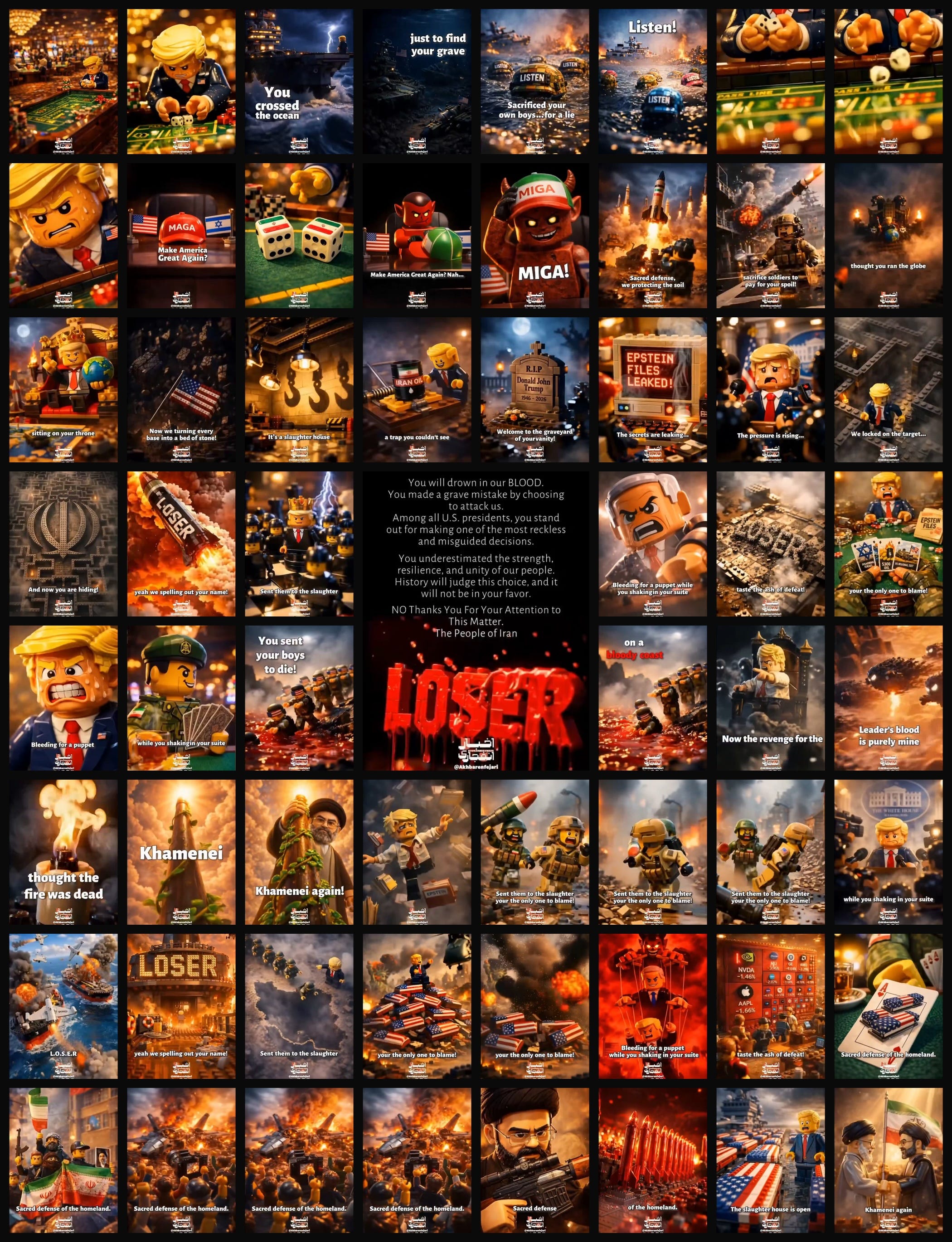
(Storyboard constructed from extracted frames of the animation. Surrounding frames illustrate the narrative escalation sequence while the enlarged central frame represents the terminal narrative payload.)
The storyboard reveals a consistent narrative structure designed to guide audience interpretation. By organizing the animation’s imagery into a spatial field, the composition exposes how the video compresses a complex geopolitical situation into a sequence of symbolic narrative phases.
The central frame is intentionally enlarged to occupy multiple grid positions. This compositional choice highlights the moment of narrative emphasis within the animation, allowing the viewer to immediately identify the symbolic focal point around which the surrounding narrative sequence is organized. Rather than functioning as a simple concluding image, the enlarged frame acts as the structural anchor of the narrative system.
Phase 1 — Delegitimization through Symbolic Metaphor
The opening scenes portray a stylized political leader gambling in a casino environment. Dice, betting tables, and exaggerated expressions frame leadership decision-making as reckless risk-taking. This establishes an early interpretive anchor: geopolitical conflict is framed as the result of irresponsible leadership rather than complex strategic dynamics.
Phase 2 — Escalation and Military Deployment
Subsequent imagery transitions to aircraft carriers, missile launches, and battlefield environments. The narrative condenses the origins of conflict into a simplified causal chain in which military escalation directly follows the earlier gambling metaphor.
Phase 3 — Soldier Sacrifice and Emotional Triggering
Images of drowning helmets, battlefield casualties, and destroyed landscapes introduce emotionally charged symbolism. These visuals shift the narrative from strategic decisions to human cost, encouraging viewers to associate leadership choices with the suffering of soldiers.
Phase 4 — Corruption and Moral Framing
The animation then introduces imagery associated with political scandal, conspiracy motifs, and accusations of hidden wrongdoing. By layering corruption imagery into the narrative, the video reinforces a moral frame in which leadership is portrayed as both reckless and deceitful.
Phase 5 — Resistance and National Resilience
Later scenes depict symbols associated with Iranian leadership, military resistance, and defensive mobilization. The narrative reframes the conflict as a defensive struggle in which national resilience counters external aggression.
Phase 6 — Terminal Narrative Payload
The final frame—placed at the center of the storyboard—delivers the explicit narrative verdict. Accompanied by accusatory text and the word “LOSER,” the message asserts moral and strategic defeat while invoking themes of historical judgment and collective sacrifice.
This structure demonstrates how generative propaganda condenses complex geopolitical events into psychologically resonant visual sequences. Rather than presenting factual argumentation, the animation relies on symbolic escalation—moving from metaphor, to conflict, to sacrifice, and finally to accusation. The result is a narrative artifact designed for rapid comprehension and emotional engagement within algorithmically mediated information environments.
In this sense, the animation does not merely communicate a political message; it constructs an interpretive framework through which audiences are encouraged to understand geopolitical events. The storyboard therefore illustrates how generative media can function as a visual narrative system—one that translates political interpretation into symbolic imagery optimized for circulation within contemporary digital ecosystems.
7. Trust Networks and Signal Survival
As narrative production accelerates and information ecosystems become increasingly saturated, audiences face a growing challenge: distinguishing meaningful signals from an overwhelming volume of competing narratives. In such environments, individuals rarely evaluate every piece of information independently. Instead, they rely on trust networks—social, professional, and institutional relationships that help filter information and guide interpretation.
Trust networks function as informal credibility infrastructures within digital ecosystems. They include individuals and organizations whose perspectives audiences consider reliable or authoritative. Journalists, analysts, subject-matter experts, community leaders, and influential online personalities often occupy these positions. Their commentary, reposts, and interpretations can significantly shape how broader audiences understand emerging events.
In saturated information environments, trust networks perform several critical functions.
Signal filtering. When audiences encounter large volumes of competing narratives, they often rely on trusted sources to determine which interpretations are worth attention.
Narrative reinforcement. Trusted voices can strengthen particular narrative frames by repeatedly referencing or endorsing them within their communities.
Credibility transfer. When a trusted actor amplifies a narrative artifact—such as a video, meme, or news report—the perceived credibility of that content can increase among their audience.
Network propagation. Narratives that move through trusted networks can spread more effectively than content circulating through anonymous or unfamiliar accounts.
These dynamics increasingly shape how narratives survive within algorithmically mediated environments. Even when platforms amplify large volumes of content, narratives that gain support from trusted intermediaries are more likely to persist in public discourse. Conversely, narratives that fail to gain traction within trust networks often dissipate quickly despite temporary bursts of visibility.
The interaction between trust networks and algorithmic systems produces a complex information landscape. Platforms may initially elevate certain narratives based on engagement metrics, but long-term narrative stability often depends on whether influential intermediaries adopt and circulate those narratives within their communities.
This dynamic also helps explain why influence operations frequently target prominent online figures or attempt to mimic the stylistic and rhetorical patterns associated with trusted voices. By embedding narratives within formats that resemble familiar commentary or analysis, actors can increase the likelihood that content will be interpreted as credible rather than propagandistic.
As information ecosystems continue to expand and generative media accelerates narrative production, the importance of trust networks as filtering mechanisms will likely increase. In environments where audiences cannot evaluate every signal independently, the individuals and institutions that mediate interpretation will play a central role in determining which narratives ultimately shape collective understanding.
The final section considers the strategic implications of these developments for governments, institutions, and societies operating within increasingly contested narrative environments.
8. Strategic Implications
The interaction of narrative systems, algorithmic amplification, generative media, and trust networks suggests that modern strategic competition is increasingly influenced by forces operating within the interpretation domain. While physical events—military actions, diplomatic decisions, or crises—remain critical components of geopolitical competition, their meaning is now rapidly constructed and contested within digitally mediated information ecosystems.
The preceding analysis suggests several implications for governments, analysts, and institutions operating within contemporary information environments.
First, the tempo of narrative formation now outpaces traditional analysis cycles. Institutional processes designed for verification, intelligence assessment, and coordinated communication require time to establish situational awareness. Meanwhile, narratives about unfolding events can stabilize across digital platforms within minutes or hours. Once these interpretations gain traction, they can shape public expectations, political pressure, and media coverage before formal institutions have an opportunity to respond.
Second, algorithmic infrastructures increasingly shape narrative visibility. Platforms optimized for engagement inadvertently function as distribution systems for influence operations. Content designed for emotional resonance, symbolic clarity, and shareability is more likely to surface within feeds and recommendation systems. Actors who understand the mechanics of these environments can craft narratives that align with algorithmic incentives, increasing the probability that their interpretations will circulate widely within digital ecosystems.
Third, generative media enables continuous narrative production. Artificial intelligence tools now allow actors to produce persuasive media artifacts—animations, synthetic imagery, stylized video, and memetic content—at unprecedented speed and scale. Rather than relying on isolated propaganda outputs, influence campaigns can generate a steady stream of narrative artifacts that reinforce the same interpretive framework across multiple formats. As illustrated in the case study examined earlier, individual artifacts often function as modular components within broader narrative ecosystems composed of symbolic imagery, slogans, visual memes, and short‑form video content.
Fourth, trust networks increasingly determine narrative durability. In saturated information environments, audiences rely on trusted intermediaries to filter signals and interpret competing narratives. Journalists, analysts, community leaders, and influential online personalities often act as interpretive gateways whose commentary shapes how broader audiences understand emerging events. Narratives that gain reinforcement within these networks are more likely to persist, while those that fail to secure trusted amplification often dissipate despite temporary algorithmic visibility.
Taken together, these dynamics indicate that strategic competition now includes a persistent contest over the interpretation of events. Influence operations increasingly function not as isolated propaganda campaigns but as distributed narrative ecosystems embedded within everyday digital communication. Symbolic imagery, memetic artifacts, and platform‑native media circulate alongside journalism, commentary, and ordinary user content, collectively shaping the interpretive environment through which audiences understand geopolitical developments.
For policymakers and analysts, adapting to this environment requires moving beyond traditional models of information monitoring. Effective analysis must account for the interaction between narrative construction, platform infrastructure, generative media production, and the social networks that mediate credibility. Understanding how these systems interact will be critical for identifying emerging narratives, assessing their potential influence, and developing strategies capable of operating within contested interpretation environments.
As digital ecosystems continue to evolve, the strategic significance of the interpretation domain will likely increase. Actors capable of navigating narrative systems, algorithmic infrastructures, and generative media capabilities will possess growing advantages in shaping how events are perceived, interpreted, and ultimately acted upon by global audiences.
9. Conclusion
The transformation of the digital information environment has fundamentally altered the relationship between events and their interpretation. Narrative systems, algorithmic amplification, generative media, and trust networks now interact to shape how audiences perceive unfolding developments. These mechanisms operate continuously within digital ecosystems, often stabilizing interpretations of events before formal analysis or institutional communication can occur.
Understanding modern conflict therefore requires recognizing that strategic competition increasingly unfolds within the interpretation domain. Narratives provide the frameworks through which audiences assign meaning to events, algorithmic systems determine which interpretations gain visibility, and generative media accelerates the production of persuasive narrative artifacts.
In this environment, influence operations are no longer confined to traditional propaganda channels. Instead, they are embedded within the infrastructure of digital communication itself. Actors capable of shaping narratives that align with platform dynamics and resonate within trusted networks can significantly influence how events are understood by global audiences.
This paper does not attempt to resolve the challenges posed by the interpretation domain. Rather, it seeks to provide a conceptual framework for understanding how narrative systems, algorithmic infrastructures, and generative media interact to shape modern information environments.
As generative media capabilities continue to expand and algorithmic platforms evolve, the contest over interpretation will remain a defining feature of modern strategic competition. Developing the analytical tools necessary to understand this domain will therefore be essential for governments, institutions, and societies navigating an increasingly contested information landscape.
About The Author
Brad N. (OODAshift) works in and around Psychological Operations and the Information Environment and is associated with the Anti-Narrative Network (ANN). His work examines how narrative, perception, and legitimacy function as force multipliers in modern conflict, and how platform- and algorithmically mediated systems shape cognition, trust, and institutional coherence.
Drawing on experience in psychological operations and national security environments, his analysis focuses on how digital platforms, narrative systems, and generative technologies influence the interpretation of geopolitical events and the stability of modern information ecosystems.
This paper is written in a personal and analytical capacity. It reflects professional judgment informed by military doctrine, strategic literature, and operational experience in influence and information environments. It does not represent the official position of the Department of Defense, the U.S. Government, or any affiliated organization.
The purpose of this paper is analytical clarity: to distinguish governed institutional decision-making and rules-based governance processes from the engagement-driven dynamics of contemporary platform ecosystems shaping civilian belief, behavior, and resilience.
Related Analysis
Brad N.
Psychological Operations in the Age of Algorithmic Influence