Washington’s Framework Revisited: Strategic Clarity Under Digital Strain

Abstract
In his 1796 Farewell Address, George Washington identified enduring vulnerabilities within the American constitutional republic—internal distortion of public judgment, factional manipulation, and the susceptibility of domestic passions to foreign influence. These concerns, once theoretical, have become operational realities in a digital environment governed by algorithms rather than deliberation. Drawing on agenda-setting, framing, and hybrid warfare paradigms, and informed by professional experience in psychological operations and strategic communication, this analysis argues that clarity is no longer merely a civic virtue but a strategic prerequisite. The paper outlines how the drift of defense-oriented information ecosystems away from intelligence norms has accelerated epistemic erosion, and proposes corrective measures for restoring informational resilience within a contested cognitive landscape.
I. Introduction
When Washington delivered his Farewell Address in September 1796, he warned that threats to the American experiment would emerge not primarily from invasion but from internal degradations of judgment and unity. He cautioned of factional opportunists who could “misrepresent the opinions and aims” of others, of foreign powers poised to exploit domestic animosities, and of the necessity of an “enlightened” citizenry capable of reasoning at a level commensurate with self-governance in a constitutional republic.¹
Two centuries later, these insights function less as historical artifacts and more as diagnostic baselines. The modern information environment—high-velocity, low-friction, outrage-optimized—has transformed Washington’s warnings into structural conditions. In professional practice spanning psychological operations and influence analysis, the shift from analog messaging to algorithmic virality has rendered objectivity fragile and discernment scarce. Washington’s framework remains a clarifying lens for understanding how informational decay threatens national strategy.
II. Washington’s Framework: Clarity as a Foundational Requirement of a Constitutional Republic
Washington’s articulation of republican governance depended on three interlocking pillars:
National unity as strategic ballast The Union is the guarantor of liberty, security, and shared prosperity. Fragmentation is a strategic vulnerability.
Resistance to factional distortion Political parties and opportunistic actors were, in his view, perennial engines of jealousy, misrepresentation, and manipulation.
Civic virtue and reasoned judgment A constitutional republic requires citizens capable of perceiving reality with enough fidelity to govern themselves.
Washington’s assertions align closely with modern communication theory. Agenda-setting research demonstrates that salience—not accuracy—drives perception.² Framing research shows how selective emphasis shapes interpretive schemas.³ When clarity erodes, adversaries do not need to attack infrastructure; they merely need to distort sensemaking.
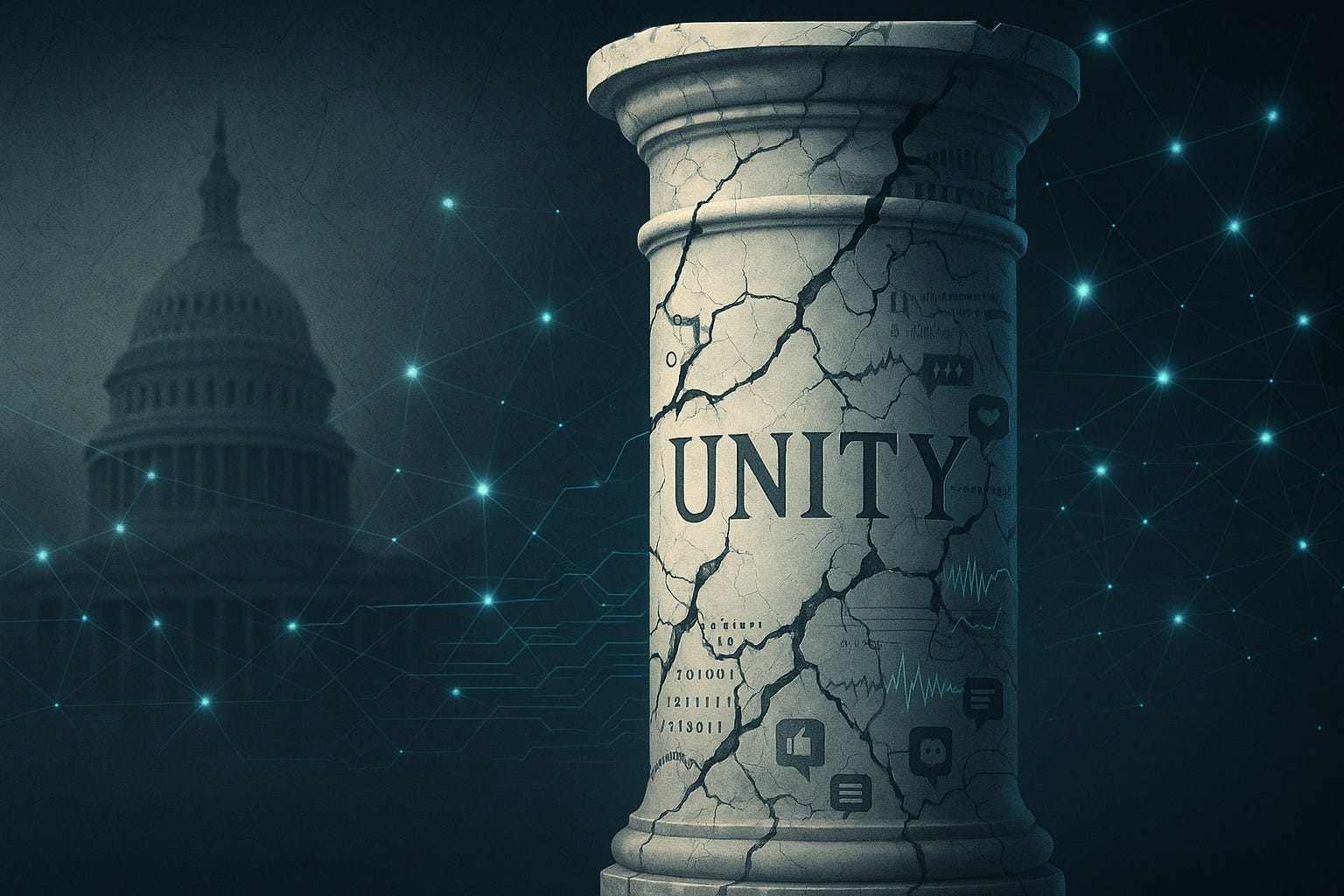
“The unity of government which constitutes you one people is also now dear to you… it is a main pillar in the edifice of your real independence… the point in your political fortress against which the batteries of internal and external enemies will be most constantly and actively… directed.”
—George Washington, Farewell Address
Washington’s emphasis on unity was not sentimental rhetoric but a strategic assessment: national cohesion functions as a cognitive and political center of gravity. His warning that internal and external actors would apply “constant and covert” pressure against this unity mirrors the dynamics of today’s digital battlespace, where algorithmic amplification accelerates precisely the kinds of fractures he sought to prevent.
III. The Paradigm Shift: Defense Information Ecosystems Detaching from Intelligence Norms
Historically, practitioners assumed that defense-oriented outlets—military-affiliated media, national security publications, and think-tank commentary—were governed by analytical discipline: objectivity, caution, adversary-centric rigor, and methodological transparency.
Over the past decade, particularly in the post‑2016 and post‑2020 media cycles, even defense-oriented digital channels have shown measurable drift toward outrage-amplifying formats and engagement-optimized commentary. Without naming specific outlets, the pattern is observable: analytical threads increasingly framed for virality rather than adversary-centric rigor.
That assumption no longer reliably holds.
As platform economics overtake institutional norms, previously sober defense channels increasingly mirror the structural incentives of mainstream media: • Virality as viability Clicks determine visibility, influence, and fiscal survival. • Emotion as accelerant Outrage consistently generates diffusion—often outperforming sober analysis. • Performance over precision Slow, rigorous, evidence-bounded communication cannot compete with rapid, affective content.
In effect, objectivity has become a structural disadvantage, and Washington’s concerns about misrepresentation are being realized through algorithmic pressure, not ideological malice. These distortions introduce cognitive vulnerabilities within institutions historically expected to function as epistemic stabilizers.
IV. Institutional Constraints: The Collapse of Neutral Intermediaries and Bureaucratic Lag
As the mediating layer between analysis and the public becomes compromised, governmental bodies inherit the burden of correcting false or misleading narratives. Yet the federal bureaucracy—by design—is optimized for precision, legality, and procedural integrity, not tempo.⁴
Government communication must navigate: • Clearance chains • Legal vetting • Multi-stakeholder coordination • Risk management protocols
Meanwhile, adversarial narratives move at: • Platform speed • Affective resonance • Exponential replication • Asymmetric cognitive advantage
Even when agencies speak with accuracy, they do so too late to anchor public understanding. Cognitive science affirms that early impressions (anchoring effects) shape downstream interpretation regardless of corrective information.⁵ This dynamic reflects Washington’s warning rendered operational in a high-velocity information environment:
“As avenues to foreign influence in innumerable ways, such attachments are particularly alarming to the truly enlightened and independent patriot… How many opportunities do they afford to tamper with domestic factions, to practice the arts of seduction, to mislead public opinion, to influence or awe the public councils!”
“Against the insidious wiles of foreign influence… the jealousy of a free people ought to be constantly awake, since history and experience prove that foreign influence is one of the most baneful foes of republican government.”
—George Washington, Farewell Address
Washington’s warning about “tampering with domestic factions” maps directly onto today’s digital threat surface. Platforms create innumerable vectors by which foreign actors can enter the cognitive environment: microtargeting, sentiment manipulation, inauthentic amplification, and algorithmic shaping of salience.
His observation that a people must remain “constantly awake” to foreign influence captures what modern strategists describe as continuous cognitive contestation. The danger he articulated—that partiality or factional alignment blinds a society to manipulation—mirrors contemporary dynamics in which digital tribes amplify narratives aligned with identity rather than reality.
In effect, Washington described the pre-digital blueprint of modern influence operations:
foreign exploitation of domestic fractures, accelerated today by tempo, automation, and platform economics.
V. Strategic Consequences: Epistemic Pollution and Decision-Making Fragility
The consequences of this tempo asymmetry extend beyond communication failure; they degrade strategic judgment itself.
Once informational integrity degrades, effects cascade into core national security functions: • Leaders misjudge threat landscapes based on refracted or sensationalized narratives. • Public support oscillates according to algorithmic stimuli rather than strategic logic. • Adversaries exploit domestic cognitive seams, achieving effects once reserved for kinetic operations.
Hybrid warfare scholarship underscores that adversaries increasingly seek decisive advantage in perceptual rather than physical domains.⁶ Yet the domestic information environment—nominally the Republic’s decision-making substrate—has entered a gray zone of its own, where OODA loops fracture at the “Observe” stage, foreclosing coherent orientation or decisive action.
Adversaries exploit this asymmetry by seizing narrative initiative through rapid inauthentic amplification, shaping the initial frame before institutional actors can stabilize observation.
VI. Prescriptive Trajectory: Reestablishing Informational Resilience
Palliatives like enhanced messaging or slow-moving commissions are inadequate. The Republic faces a structural choice:
Reinstate Intelligence Epistemology in Defense Communications • Elevate analysis over engagement metrics. • Incentivize probabilistic reasoning and evidence-forward content. • Restore the communicative ethos of decision-support rather than audience capture.
Engineer Rapid-Response Narrative Capabilities • Integrate influence operators, analysts, and communicators into high-tempo fusion cells. • Deploy accelerated truth-projection mechanisms to contest early narrative anchoring. • Build doctrinal literacy in framing, agenda-setting, and cognitive maneuver.
Return to Washington’s Standard: Clarity as a Strategic Commodity
Washington intended his warnings to “recur from time to time.” They recur now because the Republic’s informational infrastructure is under systemic strain. Clarity—once an assumed condition of civic discourse—must be redefined as a national security asset.
VII. Conclusion
Washington wrote for a fledgling republic navigating rudimentary communication channels. Yet his insights map seamlessly onto a world where information travels instantaneously and distortion scales automatically. His fears of factional distortion, foreign manipulation, and unenlightened public judgment now operate as structural risks. In strategic communication, this necessitates elevating informational hygiene to a core component of readiness and deterrence.
When clarity degrades, strategy destabilizes. When the informational substrate erodes, a republic does not need to be conquered; it merely needs to be confused.
About the Author
Brad N. (OODAshift) writes on cognitive conflict, institutional coherence, and the structural dynamics of platform‑mediated information environments. His work examines how leadership behavior, decision systems, and narrative signaling interact under sustained algorithmic pressure.
This paper is written in a personal and analytical capacity. It reflects professional judgment informed by strategic literature and operational experience in influence and information environments. It does not represent the official position of any government agency or affiliated organization.
The purpose of this analysis is diagnostic rather than partisan: to clarify structural failure modes in contemporary cognitive competition without attributing intent or assigning normative blame.
Footnotes
George Washington, Farewell Address, 1796, U.S. Senate Historical Office, https://www.senate.gov/artandhistory/history/resources/pdf/Washingtons_Farewell_Address.pdf.
Maxwell McCombs and Donald Shaw, “The Agenda-Setting Function of Mass Media,” Public Opinion Quarterly 36, no. 2 (1972): 176–187.
Robert M. Entman, “Framing: Toward Clarification of a Fractured Paradigm,” Journal of Communication 43, no. 4 (1993): 51–58.
Daniel Kahneman and Amos Tversky, “Judgment under Uncertainty: Heuristics and Biases,” Science 185, no. 4157 (1974): 1124–1131.
NATO Allied Command Transformation, Cognitive Warfare, 2020, and related NATO doctrine on the cognitive domain.
Frank G. Hoffman, “Hybrid Warfare and Challenges,” Joint Force Quarterly 52 (2009): 34–39.